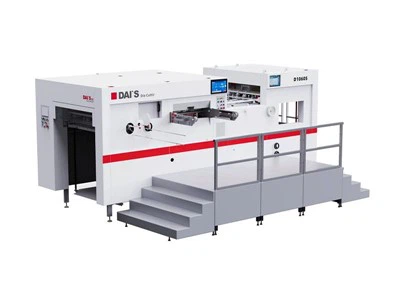
The 1060S automatic die-cutting machine is a kind of plate die cutting machine widely used in packaging printing industry. It continuously processes paper and cardboard of various specifications through a sequence of operations such as automatic feeding, conveying, positioning, die-cutting and feeding. Its specific application range depends on die cutting pressure, paper feed system, die cutting tool (forme) and material thickness.
In general, the 1060S automatic die-cutting machine is mainly suitable for processing a certain thickness of cardboard, whiteback board (SBS/FBB), gray board, color carton board, corrugated board, and so on, according to the specific configuration, can also process a certain special paper.

1.Cardstock
Carton is a common material for the 1060S automatic die-cutting machine.
The carton has a certain thickness and hardness and can be further die-cut and creased after printing. As a result, it is often used to manufacture a variety of packaging boxes, paper bags, hanging signs and paper displays.
When processing cardboard, according to the thickness of the paper feed height, transmission pressure and die cutting pressure to prevent paper feed instability, deep creases or die cutting problems.
2.White-back Board (SBS/FBB)
The whiteback board with smooth surface, good rigidity and excellent printability has been widely used in packaging industry.
After printing, the whiteboard is usually die-cut and creased to form the final packaging structure, such as:
Food packaging boxes
Cosmetic packaging boxes
Pharmaceutical packaging boxes
Gift boxes
Colorful cardboard boxes
Hang labels and cards
For printed or laminated backboards, care must be taken to minimize surface scratching, dislocations and uneven creases when die-cutting.
3. Grey Board and Thicker Paperboard
Some machines in the 1060S class can also handle thicker cardboard, but actual capability depends on the machine's pressure capacity and structural design.
Thicker paperboard has higher rigidity, greater requirements for die cutting pressure and die cutting tool conditions. Insufficient pressure may result in incomplete cutting, uncut (notched) joints or uneven edges. Therefore, in the processing of thick paperboard, cannot just rely on the paper's basis weight, but also need to consider actual thickness, material structure and die molding design.
4. Color box cardboard
Color boxes is a typical application the 1060S automatic sheet-fed die-cutting machine.
Color box production usually involves multiple stages such as printing, laminating, die-cutting, creasing and molding. Die-cutting machines are mainly responsible for cutting the printed paperboard into flat shapes designed to create crease lines.
Therefore, the stability and positioning accuracy of the paper feed is very important to the production of color box.
If the paper before moving into the die cutting area, even if the die forming accuracy is very high, there will be problems such as inconsistent edges or dislocation of creases.
5. Corrugated Board
Some 1060S automatic die-cutting machines can process thin corrugated cardboard, commonly used in corrugated color boxes, small shipping cartons, display packaging and other products.
Maximum thickness capacity of corrugated cardboard varies widely from machine to machine; some "1060" models can handle thickness of about 4mm, while others support thicker materials based on their structural design.
Therefore, when selecting equipment, you cannot simply assume that all "1060S" models corrugated board can be processed the same thickness of corrugated board.
If a company mainly produces corrugated packaging, it should focus on verifying the thickness of corrugated board allowed by the machine, maximum die-cutting pressure and actual production speed.
6. Glue and Printed Paperboard
Post-treatment cardboard-such as laminate or varnish-may also require to be die-cut.
The surface of these materials is usually smoother than standard paper, so friction and paper separation efficiency must be taken into account when entering paper at high speed.
Automatic paper feed system requires to be adjusted according to material characteristics to prevent double paper feed, paper feed blockage or surface scratches.
The stability of paper feed is very important in mass production of color boxes because it directly affects the continuous operation of the whole production line.
7. Different paper thickness requires different processing settings.
The 1060S automatic sheet-fed die-cutting machine does not use the same parameters for every type of paper. When material thickness changes, you may require to adjust feed height, suction position, feed speed, die cutting pressure and creasing parameters.
For thinner paper, emphasis should be placed on sheet separation and continuous feed paper; for thicker cardboard, emphasis should be shifted to die-cutting pressure and die-cutting conditions.
Therefore, in actual production, according to the thickness of material and paper characteristics should be targeted adjustment.
8. When choosing materials, consider the condition of the paper.
In addition to the type of paper, the condition of the paper itself will also affect the processing effect of the 1060S die-cutter.
For example, if the paper is damp, warped or deformed, it will lead to automatic feed of paper suction instability, resulting in misaligned positioning.
For corrugated cardboard, the flatness of the board will also affect the quality of die cutting.
Therefore, the smoothness, thickness, moisture content and stacking of the paper should be inspected before production commences to ensure that the material entering the machine is in a stable condition.
9. Different materials are suitable for different packaging products
The 1060S automatic die-cutter is characterized by a large processing format, suitable for a variety of paper packaging products.
Common products include:
Folding colored cardboard boxes
Food packaging boxes
Make-up boxes
Pharmaceutical packaging boxes
Gift boxes
Paper bags
Hanging labels
Greeting cards
Labels
Corrugated carton
Paper Exhibits
To determine which products can be actually processed, paper specifications, die cutting board structure and equipment configuration need to be considered.
X. How to tell if the 1060S is right for your paper?
If a company plans to buy the 1060S automatic die-cutter, it should not rely solely on the machine's name, but rather match its specific material parameters to the machine's specifications.
Verification is recommended in the following areas:
First, determine the thickness and weight of the paper.
Understand the range of materials that machines can process to avoid exceeding their design capabilities.
Secondly, determine the corrugated board thickness.
If the main application involves corrugated or colored cartons, the maximum allowable thickness is a key factor.
Third, determine the maximum size of the paper.
The 1060-series machines are typically designed for larger paper formats, but maximum paper feed size may vary from machine to machine. Fourth, determine the die-cutting pressure.
Thicker or stiffer paperboard requires higher die-cutting pressure.
Fifth, material testing should be carried out effectively.
If the company uses special paper, laminate or thicker materials, it is better to test with actual production materials rather than relying on theoretical parameters.
Frequently Asked Questions
Can the 1060S automatic die-cutting machine process white cardstock?
Yes. ' White cardstock are commonly used for this type of equipment; specific applicable syntax should be verified in accordance with equipment specifications.
Can the 1060S process corrugated cardboard?
Some 1060S units can be processed thin corrugated cardboard, but the permitted thickness varies according to model, specific equipment configuration for reference.
Does the thick paper require more of a die-cutter?
Generally, yes. Thicker board requires high die cutting pressure, great die strength and superior machine rigidity.
Can the 1060S laminate be die-cut?
In general, yes, but it requires to be adjusted to the material structure and the machine's sheet-feeding system. Care must also be taken to prevent surface scratches and sheet slippage.