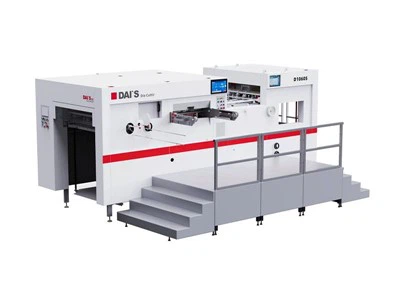
With the increasing demand of packaging, labeling, electronic parts, paper processing and other industries for production efficiency and product quality, more and more enterprises are considering upgrading from traditional manual die-cutting equipment to automatic feed die-cutting machine.
But, for many purchasing managers, what is the difference between automatic feed die-cutting machines and manual die-cutting machines? Which equipment is better suited to their production needs?
As a die-cutting equipment manufacturer, we often receive similar inquiries from our customers. In fact, the two devices differ greatly in terms of productivity, processing accuracy, labor costs and application scenarios. This paper will analyze from six aspects.
1.Different Production Efficiency
Production efficiency is the most obvious difference between automatic feed die-cutting machine and manual die-cutting machine.
Manual die-cutting machines require operators to feed, locate and recycle a piece of material at a time, relying on manual labor throughout. As a result, the capacity of the device is easily limited by the speed of manual operation when the order volume is large.
Automatic feeding die cutting machine is equipped with automatic feeding system, which realizes continuous feeding and continuous die cutting, and greatly reduces the time of manual intervention.
For companies that primarily produce cardboard boxes, color boxes, labels, self-adhesive labels and electronic accessories, automated feeding equipment can significantly increase unit time production and help them fill order deliveries faster.

2.Different labor costs
In traditional die-cutting production, it is often necessary to be responsible for the input and receipt of materials.
With the increase of labor cost year by year, more and more enterprises begin to pay attention to the cost advantages of automation equipment.
Automatic paper feeding die-cutting machine, through automatic paper feeding, positioning, transmission and other functions, can reduce the number of operators.
For large and medium-sized manufacturing enterprises, although the initial investment is higher than manual equipment, in the long run, it can effectively reduce labour costs and minimize production fluctuations caused by the movement of staffs.
3. Different Die-cutting Accuracy
Die cutting accuracy directly affects product quality.
In the process of manual feeding, the artificial material placement and feeding speed is wrong, which can easily lead to misalignment and inconsistent dimensions and so on.
Automatic feeding die cutting machine is usually equipped with high-precision positioning and servo control systems, which keeps feed stability and repeatability accuracy.
Especially in electronic insulation materials, precision labels, medical packaging and other industries, high precision die-cutting has become an important customer demand.
Therefore, for products with higher quality requirements, automatic feed die-cutting machines generally have an advantage.
4. Different Applicable Order Types
Different companies face different order structures.
If the company mainly undertakes:
Small batch orders;
Sample production;
A wide range of products;
Limited budget;
Then manual die-cutting is still an economical and practical option.
However, if the company regularly produces:
Bulk packaging products;
Labeled roll products;
Long-term fixed orders;
Continuous production of products;
Automatic feed die-cutting machine can better meet production needs.
From the point of view of actual customer application, the larger the order volume, the greater the advantage of automated equipment.

5. Different operational stability
Production stability directly affects the consistency of the product.
The production effect of manual die-cutting machine depends to some extent on the operator's experience and skill level.
Processing quality may vary from shift to shift and from employee to employee.
Automatic feeding die cutting machine through program control, the feeding rhythm and processing parameters to achieve the unity, help to maintain the stability of product quality.
Stability is often more important for export orders and high-standard customer projects than simple production speed.
6. Different Investment Costs and Payback Periods
From a cost perspective, manual die-cutting machines are usually cheaper and suitable for businesses with limited budgets or start-ups.
The initial investment of automatic feeding die-cutting machine is relatively high due to the addition of automatic feeding systems, servo control systems and intelligent control module.
But from a long-term perspective, automated devices can help businesses:
Enhancing productive capacity;
Reduce labour costs;
Reduce material waste;
Improving product consistency;
Shortened delivery cycles.
Therefore, for enterprises with stable orders and large production volumes, automatic feed die-cutting machine usually has a high return on investment.
How to choose the right die cutter?
There are no absolute criteria for equipment selection, which needs to be based on the actual production needs of the company.
In general:
Start-ups should prioritise manual die-cutting machines
Semi-automatic equipment can be selected for small and medium-sized processing plants;
It is suggested that large production enterprises choose automatic feeding die cutting machine.
For enterprises with high accuracy and efficiency, automatic production solutions should be preferred.
In the process of selecting equipment, price, production efficiency, precision requirements, labor costs and future expansion plans are taken into account.

Conclusion:
Automatic feed die-cutting machine and manual die-cutting machine have their own application scenarios.
For small batch production, limited budget enterprises, manual equipment still has some advantages, and for enterprises seeking high efficiency, high quality, large-scale production, automatic feed die-cutting machine is undoubtedly a more promising option.
With the accelerating trend of manufacturing automation upgrades, more and more enterprises introduce automatic feeding die cutting equipment to improve market competitiveness and production efficiency.
Frequently Asked Questions
Q1: What industries are automated feed die-cutters suitable for?
Automatic feed die-cutting machine is widely used in packaging printing, label printing, electronic accessories, insulating materials, automotive interior decoration, medical packaging, paper processing and other industries. Question
2: What materials can automatic feeders process?
Common processing materials include paper, corrugated cardboard, self-adhesive labels, PET, PVC, EVA foam, double-sided adhesive tape, insulation, composites, etc.
Q3: To what extent can fully automated feed die-cutting machines improve production efficiency?
Specific improvements depend on product specifications and production processes. Many companies can achieve capacity growth of 30%-200% or more compared to traditional artificial feeding methods.
Q4: Is the maintenance of automatic feed die-cutting complex?
Modern automatic feed die cutting machine adopts modular design. Daily maintenance mainly includes cleaning, lubrication and inspection of vulnerable parts, making maintenance relatively simple.
Question 5: Is automatic feed die-cutting worth investing in?
For companies with large orders, high labor costs, or plans to expand capacity, automated feed die-cutting machines can generally recoup investment in a relatively short period of time by increasing efficiency and reducing costs.